
New study reveals how immune cells and cancer interact in real time
Scientists at The University of Copenhagen and Herlev Hospital have unveiled a breakthrough study that sheds new light on how cancer and the immune system interact at the molecular level.
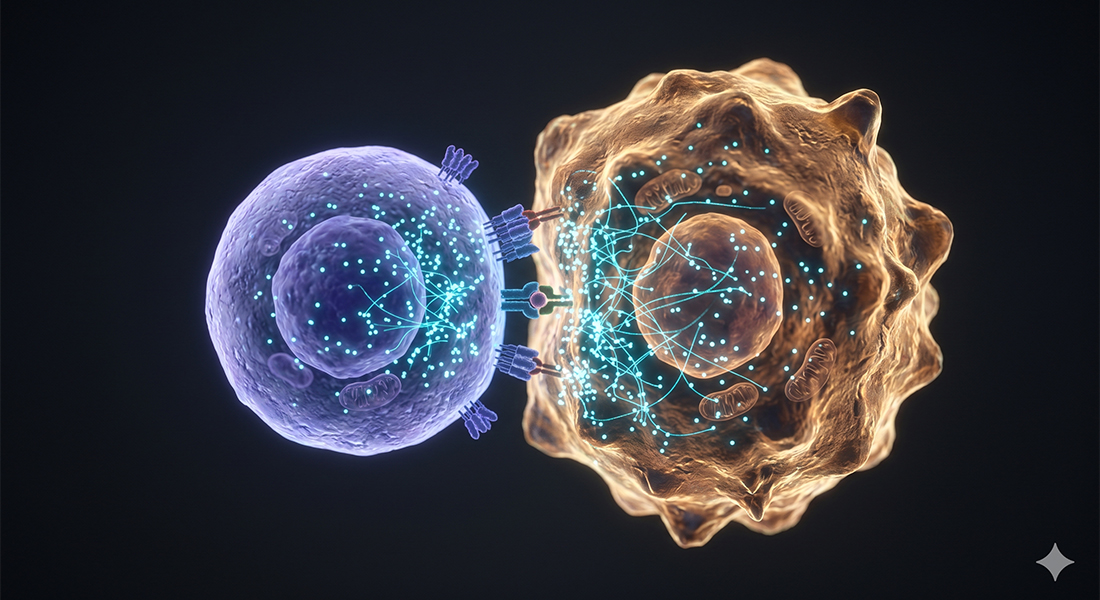
In collaboration with the National Center for Cancer Immune Therapy (CCIT-DK) at Herlev Hospital the Olsen Group at the Novo Nordisk Foundation Center for Protein Research (CPR) at the University of Copenhagen has recently found a powerful new method to observe, in real time, the intricate biochemical battle between cells in the skin cancer type melanoma and the body’s own cancer-fighting T cells. The research groups have uncovered the specific tactics that tumors use to survive, and the mechanisms T cells use to kill.
The research has been published in the peer-reviewed scientific journal Cell Reports Medicine in the article “The proteomics and phosphoproteomics landscape of melanoma under T cell attack”.
Read the article in Cell Reports Medicine
A new method to analyze a mixed co-culture
The researchers studied the interaction between melanoma cells and T cells taken directly from the same patient. By growing them together in a dish and not separating them, they could observe how they react to one another real time during a direct immune attack.
Historically, analyzing phosphorylation of proteins globally in a mixed co-culture was a major hurdle because physical sorting ruins the data.
“We solved the analyzing problems by combining stable isotope labeling with Data-Independent Acquisition. This allows for an incredibly deep and accurate measurement of thousands of signaling events in mixed populations at once,” says Assistant Professor (CPR), Giulia Franciosa, who is first-author of the article.
Isotope labeling is a chemical "tagging" system that gives each cell type a unique signature and allows the researchers to analyze the mixed samples using mass spectrometry-based proteomics.
“The trick is to distinguish between the two cell types without physically separating them. When you separate the cells, it is slow and introduces technical artifacts that distort the results,” says MD Marco Donia (CCIT-DK).
A way to help T cells overcome the tumor's survival tactics
While immunotherapy has transformed cancer care by using the body's own immune system as a weapon, many patients still do not respond to these treatments. The new research from the Olsen Group reveals a better understanding of why this is happening:
“When some patients do not respond to the immunotherapy it is because we don't fully understand the battle happening at the molecular level. By preserving and analyzing the "on/off" switches inside the tumor cells versus the T cells individually, we add a new layer of understanding to this cellular conflict,” says professor Jesper V. Olsen (CPR), the last author of the article.
This allows the researchers to identify better markers to predict treatment success and find new ways to help T cells overcome the tumor's survival tactics.
We can use the results to design smarter diagnostics
Taken together, this work shifts the field from a static view of immune–tumor interactions to a dynamic understanding of the molecular machinery that drives them. By revealing functional protein activity in real time, the study not only identifies actionable biomarkers but also uncovers tumor defense mechanisms activation that can be therapeutically targeted.
“Our findings provide a window into how the immune system and tumors actively respond to each other at the protein level,” says Jesper V. Olsen. “By understanding this interplay in real time, we can begin to design smarter diagnostics and more effective combination therapies.”
Looking ahead, these insights pave the way for more precise patient stratification and novel treatment strategies, offering a valuable platform for continued discovery and validation across the research community.
Topics
Contact
Professor, Jesper Velgaard Olsen jesper.olsen@sund.ku.dk
Assistant Professor, Giulia Franciosa giulia.franciosa@sund.ku.dk
Communications Advisor, Ingeborg Auken Beck Ingeborg.beck@adm.ku.dk